UX Research · Moderated usability study · Comparative benchmark · 2024

How Fans Experience Ticket Waitlists

Improved clarity around ticket waitlist friction by studying how fans discover, join, and experience official waitlists across sports teams.

Celtics waitlist competitive analysis

Type

Sponsored project by Boston Celtics

Role

UX Researcher

Method

Moderated remote usability testing

Participants

6 sports fans across three team waitlist experiences

Description

I served as a UX Researcher on a sponsored project for the Boston Celtics, responsible for planning and executing a comparative usability study to benchmark how competitor sports organizations handle fan ticket waitlists.

I ran 6 moderated remote testing sessions and analyzed fan interactions with the Atlanta Dream, Montreal Canadiens, and Orlando Magic waitlist experiences.

Using thematic analysis, I identified friction points - unclear terminology, missing next steps, and unreliable email delivery - then translated insights into actionable recommendations to improve fan trust and conversion.

Skills

Moderated Usability TestingCompetitive AnalysisThematic AnalysisAffinity MappingInsight SynthesisStakeholder Presentation

TL;DR 🧾

Fans often defaulted to resale platforms when tickets were sold out, but viewed official waitlists as more trustworthy if they offered clear communication and fewer unknowns.

I studied three team waitlists and found that the experience depended on three moments: finding the waitlist, joining it, and receiving clear follow-up communication.

AT A GLANCE

3

Competitor Teams Benchmarked

Atlanta Dream, Montreal Canadiens, and Orlando Magic - same tasks across all three

6

Participants Recruited

Sports fans across a range of engagement levels, from casual fans to season ticket holders

Context / Business Goal

Why this study mattered

The Celtics wanted to understand how official waitlist experiences shape fan trust, engagement, and purchase intent when tickets are unavailable. To benchmark what works and what breaks, we compared the waitlist journeys of three competitor organizations.

Rather than auditing their own product in isolation, the goal was to identify patterns across the industry, surfacing both best practices and systemic gaps that informed targeted recommendations.

🎯 Increase conversion

Identify barriers preventing fans from completing the waitlist sign-up process.

🤝 Build fan trust

Surface messaging and UX patterns that help fans feel confident and informed.

📊 Competitive benchmarking

Analyze 3 competitor waitlist flows - Atlanta Dream, Montreal Canadiens, Orlando Magic - to extract best practices.

Problem / Research Question

How fans think about waitlists before we even started testing

Before testing, we wanted to understand how fans thought about waitlists in the first place. Many participants said their first instinct after seeing sold-out tickets was to check resale platforms like StubHub.

They saw official waitlists as more trustworthy, but only if they offered clear confirmation, updates, and visibility into what happens next. Without those signals, the official path felt no more reliable than a third-party reseller.

Research Question / HMW

How might official team waitlists feel like a trustworthy, worthwhile alternative to resale platforms?

Teams benchmarked

Atlanta Dream logo

Atlanta Dream

Simple form, low friction

Montreal Canadiens logo

Montreal Canadiens

Clear navigation placement
Orlando Magic logo

Orlando Magic

Post-submission uncertainty

Methodology 🔬

Approach

How we evaluated the end-to-end experience

To evaluate the end-to-end experience, I ran a moderated remote usability study using a qualitative think-aloud protocol. We recruited sports fans who were willing to sign up for a waitlist and compared three team waitlist experiences across the same set of tasks.

Sessions were recorded and transcribed. Two researchers independently coded transcripts using thematic analysis, then affinity-mapped findings into clusters to identify systemic patterns.

MethodModerated Remote Usability Testing
ProtocolQualitative think-aloud
AnalysisThematic analysis + affinity mapping
PlatformUserTesting.com

6

Participants

Sports fans recruited

3

Teams tested

Competitor waitlist flows

4

Core metrics

Per task, per session

1

Platform

UserTesting.com

Metrics captured

Time on taskTask completionSatisfactionHelpfulness

Journey Framework 🗺️

3 Stages

3 stages that shaped every session

To make the comparison easier across teams, I broke the waitlist experience into three stages. This framework helped identify where expectations were being met, where users hesitated, and where communication broke down.

01

Finding the waitlist

Can fans locate the waitlist entry point naturally? Does the navigation label and placement match their mental model?

02

Joining the waitlist

Is the sign-up form short and intuitive? Do fans know what they're committing to and what happens after they submit?

03

Confirmation email

Does the follow-up communication build trust? Do fans know what comes next and feel confident their spot is secured?

Synthesis

Research Synthesis

After testing, I grouped observations by journey stage rather than by team. This helped surface recurring patterns in discoverability, sign-up clarity, confirmation, and follow-up communication, and made the comparison across teams easier to evaluate.

Grouped raw observations by journey stage to identify recurring usability patterns across teams.

Findings 🔍

Three moments that defined the waitlist experience, analyzed across all competitor platforms.

A

Finding the waitlist

Users struggled to locate the waitlist entry point

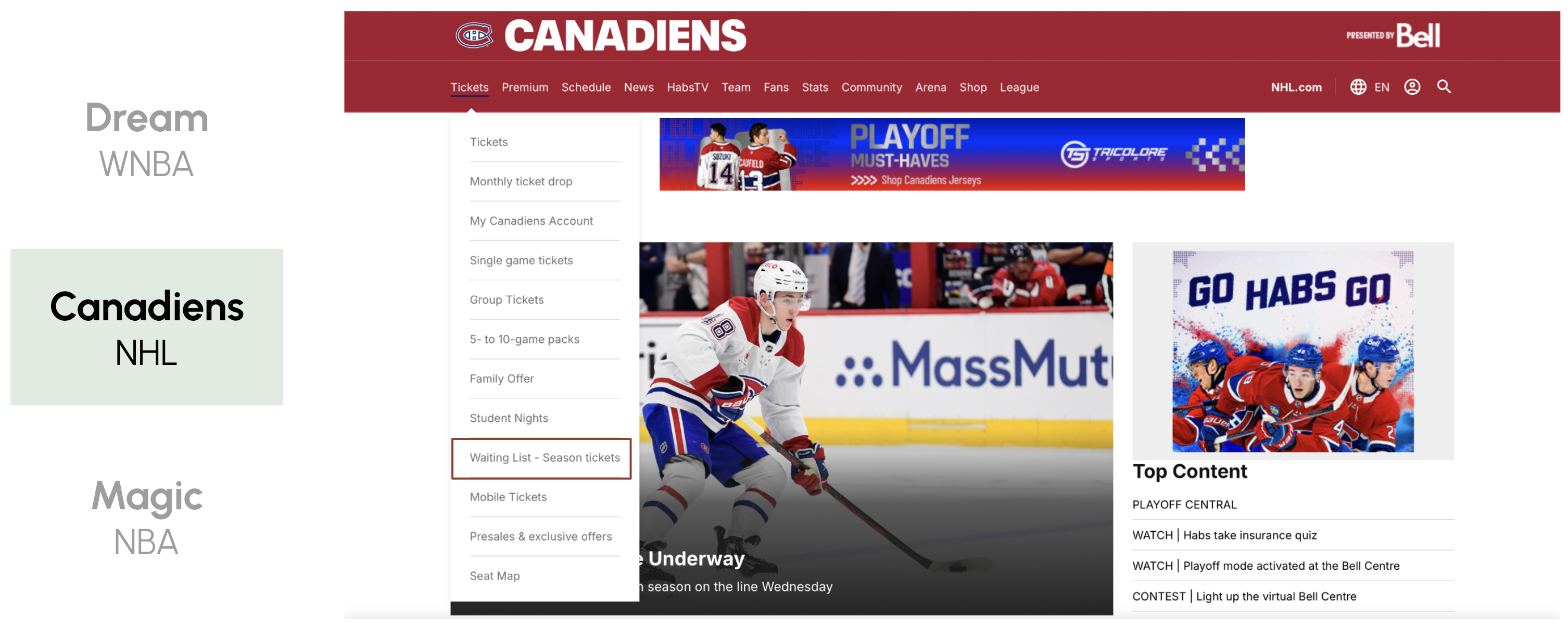
Participants responded positively when the waitlist was clearly labeled and easy to find. The Montreal Canadiens performed well here because the waitlist appeared where users expected to see ticket options, making the next step feel obvious.

✓ What worked

Participants responded positively when the waitlist was clearly labeled and easy to find. When it appeared where they expected ticket options, the next step felt obvious.

What worked - waitlist entry point

✗ What broke

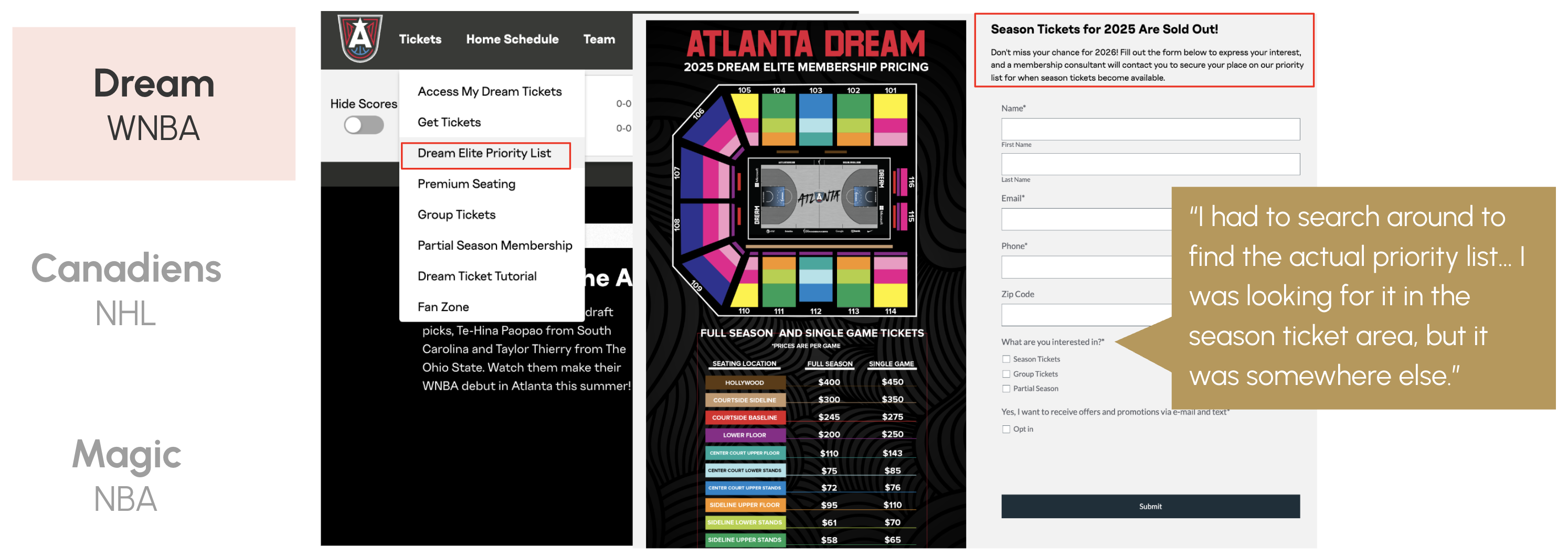
Some teams used inconsistent naming - “priority list” or “interest sign-up form” instead of “waitlist.” This created hesitation and made participants question whether they were even in the right place.

What broke - inconsistent waitlist naming

Key takeaway

Use plain, familiar language like “Waitlist” and place it where users naturally look when tickets are sold out.

B

Joining the waitlist

Form friction and unclear next steps slowed sign-ups

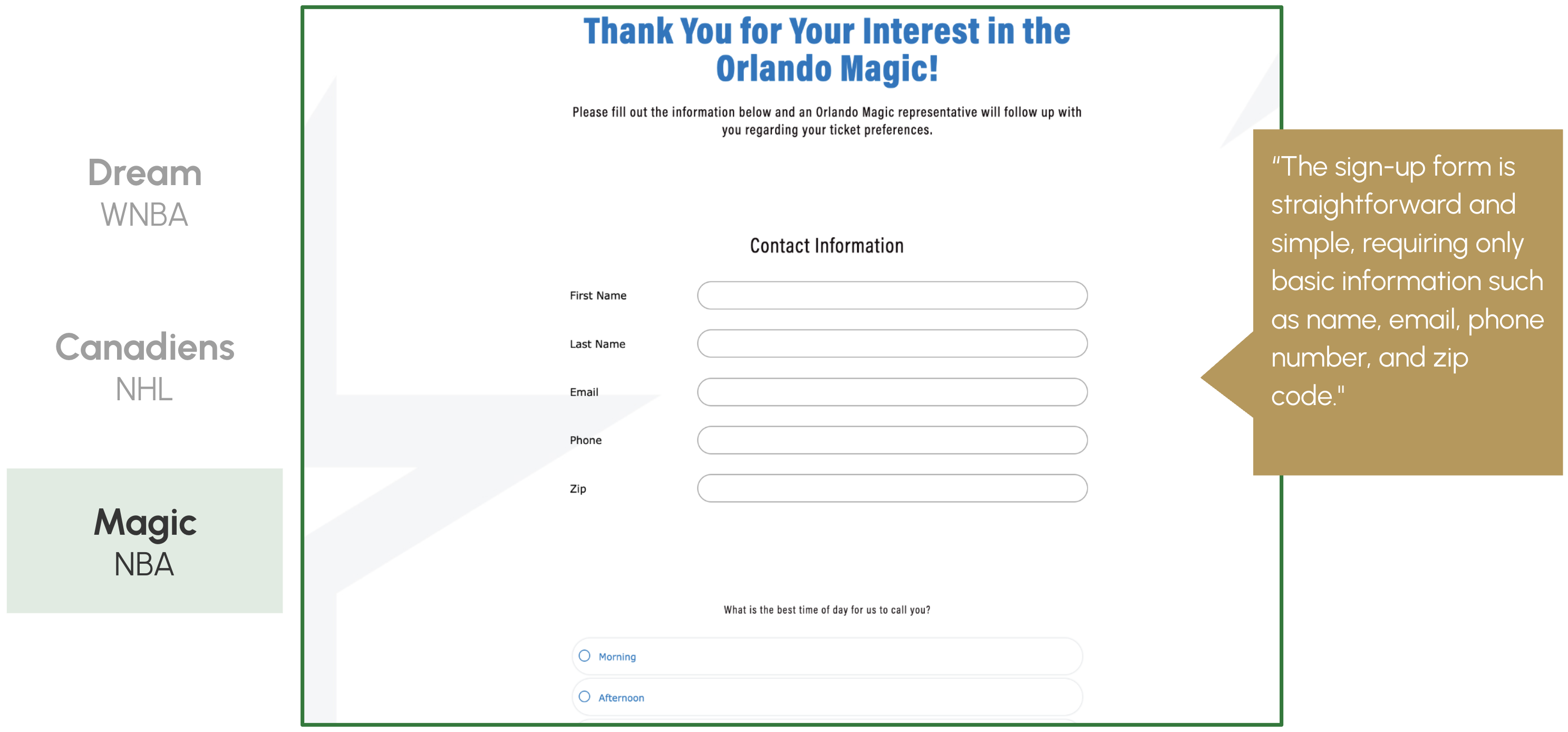
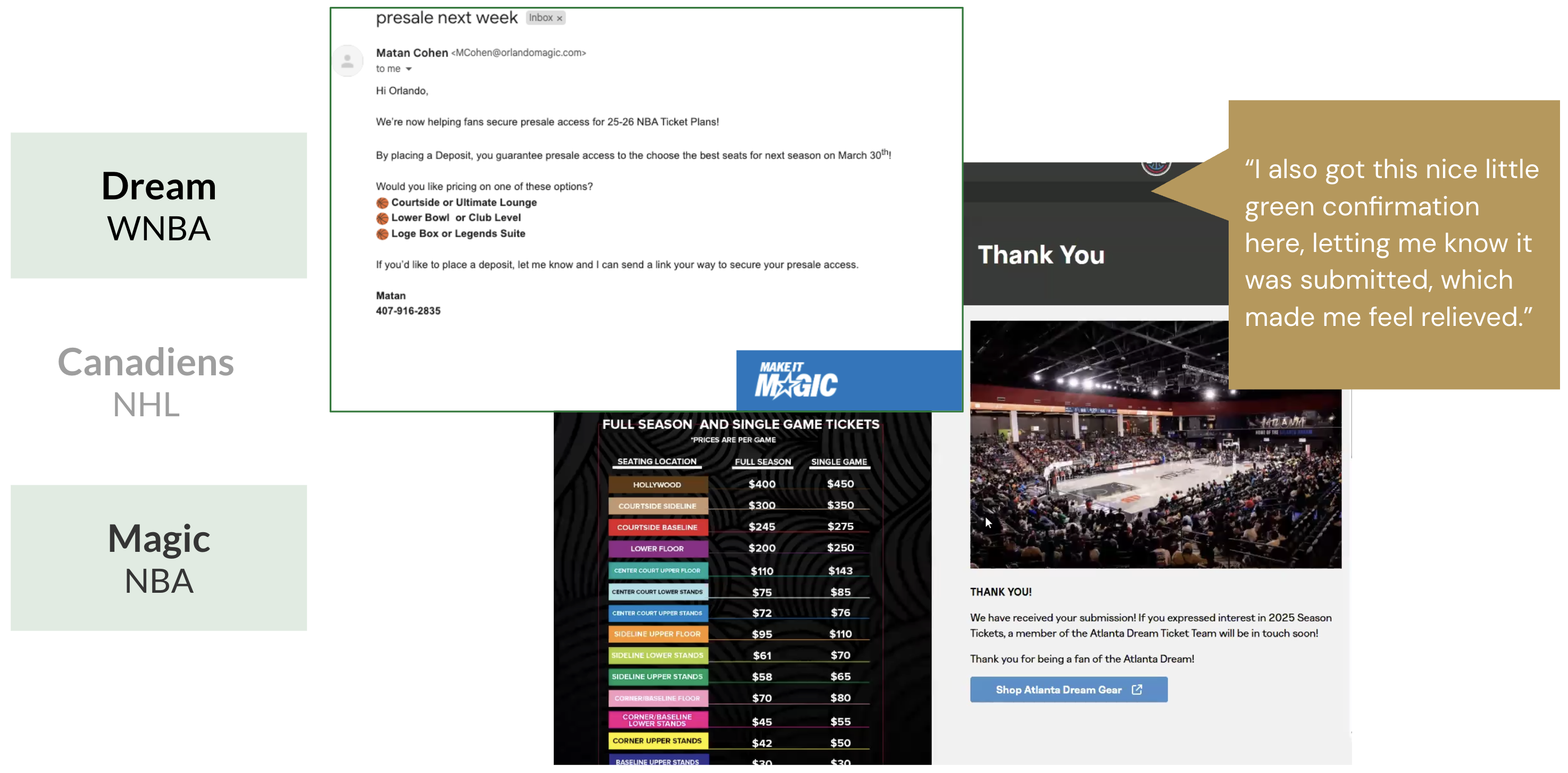
Participants liked sign-up forms that were short, intuitive, and required only basic information. The Atlanta Dream and Orlando Magic both performed well when forms felt quick to complete and low effort, but clarity about what came next remained a problem.

✓ What worked

Short, intuitive forms requiring only basic information felt low effort. When teams kept the form lightweight, participants completed the task quickly and with confidence.

What worked - lightweight sign-up form

✗ What broke

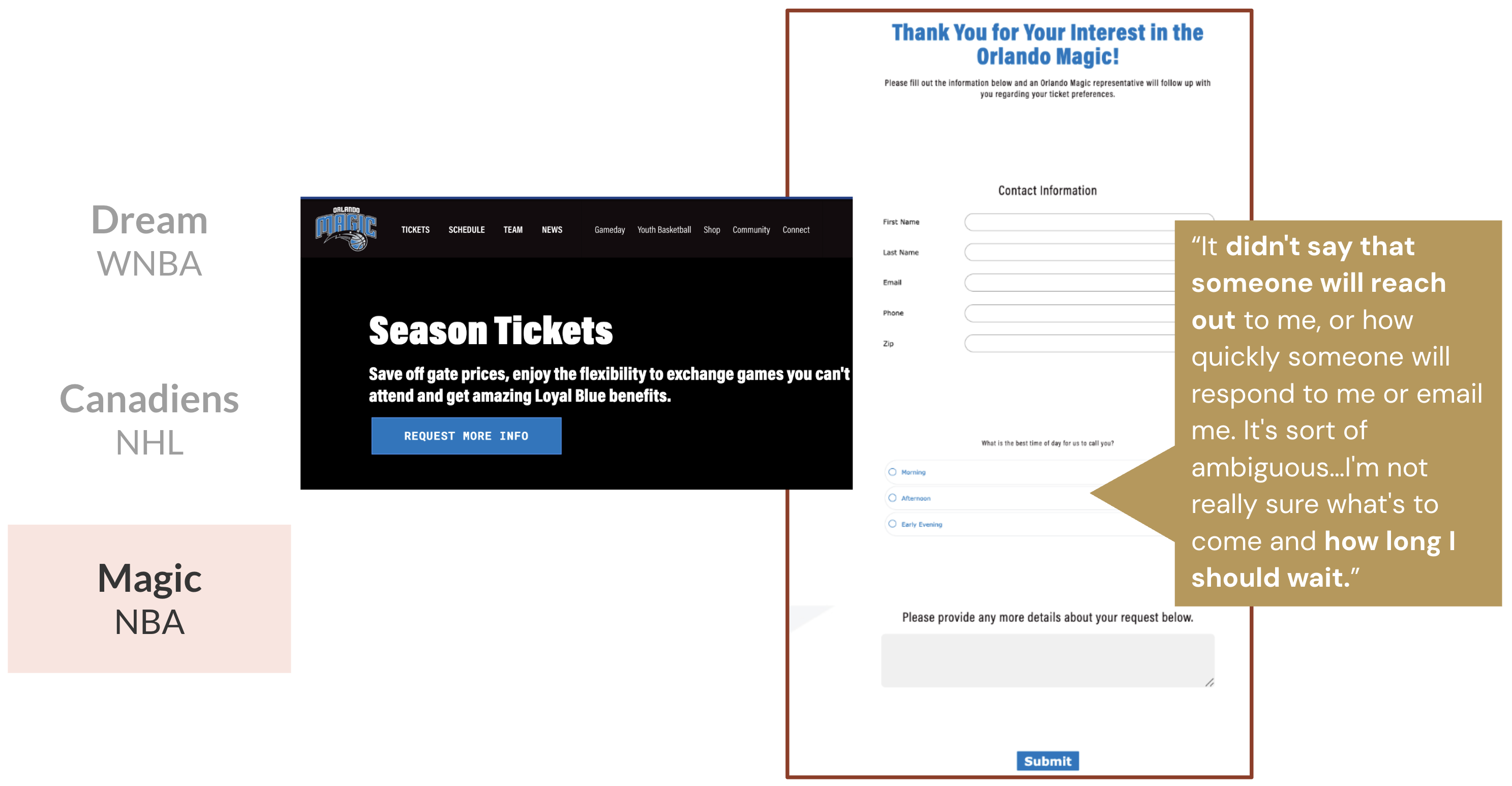
The Orlando Magic created uncertainty around what happened after submission and what they were signing up for. Participants did not know who would contact them, when they would hear back, or what joining the waitlist actually meant.

What broke - unclear next steps after submission

Key takeaway

Keep forms lightweight, but clearly explain what users are signing up for and what they should expect next.

C

Confirmation email

Post-signup communication fell short of fan expectations

The confirmation email was the final moment of trust, and the most commonly overlooked. Participants valued emails that included next steps, such as when tickets might become available or what to do next. They also appreciated immediate visual confirmation after form submission.

✓ What worked

Participants valued confirmation emails that included next steps, such as when tickets might become available or what to do next. They also appreciated immediate visual confirmation after form submission.

What worked - confirmation email with next steps

✗ What broke

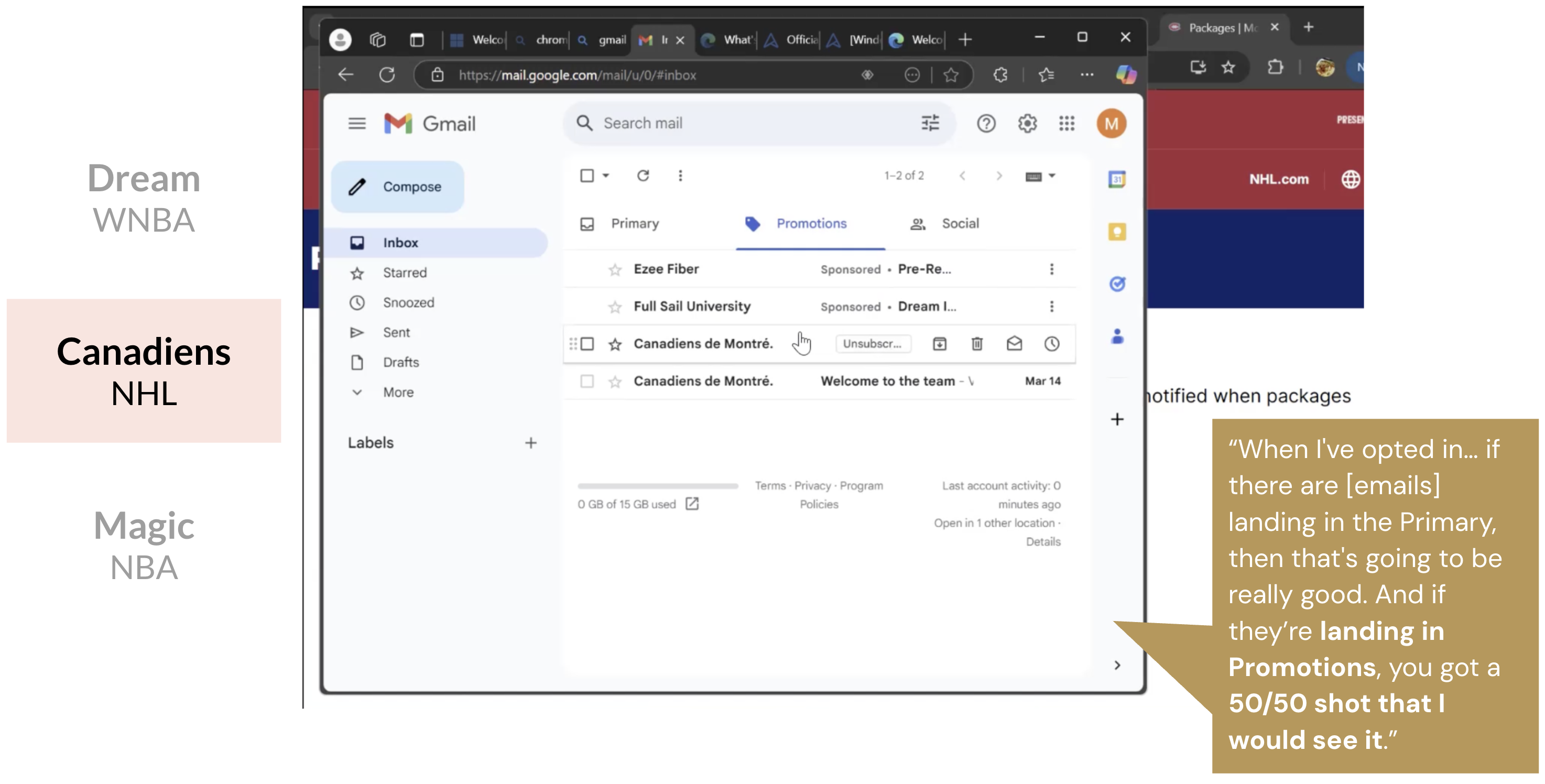
Several participants worried they would miss important follow-up emails because Gmail filtered them into the Promotions tab rather than the Primary inbox. This made the experience feel less reliable, even when the team had technically sent the email.

What broke - confirmation email filtered to Promotions tab

Key takeaway

Confirmation is not enough - post-sign-up communication must be visible, timely, and easy to trust.

Recommendations 💡

Action items

Translating friction into decisions

Based on the study, I would recommend that sports teams focus on four areas, each mapped directly to a friction pattern observed across the three waitlist flows.

01

Standardize waitlist language

Use the word "Waitlist" consistently across navigation, buttons, and confirmation copy. Inconsistent labels like "priority list" or "interest form" create hesitation before fans even start.

02

Reduce ambiguity after sign-up

Clearly explain next steps and timing immediately after submission. Fans need to know who will contact them, when, and what joining the waitlist actually means for their ticket chances.

03

Design emails for visibility and action

Confirmation emails should include next steps, a timeline, and a way to manage or check waitlist status, not just acknowledge sign-up. Consider inbox deliverability and Promotions tab filtering.

04

Treat the waitlist as a trust-building journey

The sign-up form is one moment in a longer experience. Teams that invest in communication before and after the form earn more fan confidence and higher intent to convert.

Limitations / Future Research 🔭

Research judgment

What we could not answer - and where to go next

This study captured two moments in time: signing up and reviewing the inbox one week later. We signed up using dummy accounts only one week in advance, which meant participants saw just one or two emails, not enough to observe the full post-sign-up arc.

Study limitations

One-week account setup window

Dummy accounts were created only one week before sessions. This meant participants only encountered 1-2 emails, giving us an incomplete picture of long-term post-sign-up communication.

Simulated sign-up context

Participants were asked to act as if they wanted to join a waitlist. Real purchase motivation and urgency could affect behavior and perceived friction differently.

Generalist fan recruitment

Participants were not fans of the specific teams tested. Their reactions to trust signals, team branding, and communication may differ from loyal fans with existing team relationships.

If I extended this work

Run a longitudinal study observing how fans experience the wait over weeks or months, not just the sign-up moment

Recruit fans of the specific teams being tested so task instructions match their real-world mental models

Tailor task instructions more closely to each team's sign-up flow to reduce artificiality

Set up accounts further in advance to capture a fuller picture of post-sign-up communication over time

Reflection 🪞

Takeaways

What I took away from this project

This project taught me that usability issues in service experiences often come from expectation gaps, not just interface friction. The biggest takeaway was that trust in a waitlist is shaped by communication across the full journey, not only by how easy the form is to complete.

Expectation gaps are harder to spot than interface errors

Participants rarely got stuck on the form itself. They got stuck on not knowing what would happen next, a gap that no amount of UI polish can fix without better communication.

Competitive research sharpens your questions

Studying three platforms side by side made it much easier to distinguish team-specific issues from industry-wide patterns, and helped us prioritize which findings mattered most.

End-to-end product and UX designer crafting thoughtful digital experiences.

Built with Readdy & iced matcha lattes 🍵