Custom GPT, Demand Forecasting, B2B SaaS, 2024

Ikigai Bot for Delta Children

Improved trust and relevance in AI-assisted demand planning by designing a forecasting companion for Delta Children.

Ikigai Bot for Delta Children

Role

UX Designer and Researcher

Team

1 UX Designer, 3 UX Researcher, 1 Project Manager

Date

Sep 2024 โ€“ Dec 2024

Description

As a UX Designer and Researcher, I designed the bot experience to make AI-driven demand planning feel more trustworthy, clear, and usable. I led the end-to-end design and refined the bot's persona through prototyping and usability testing so it could support planners as a transparent โ€œthinking buddy.โ€

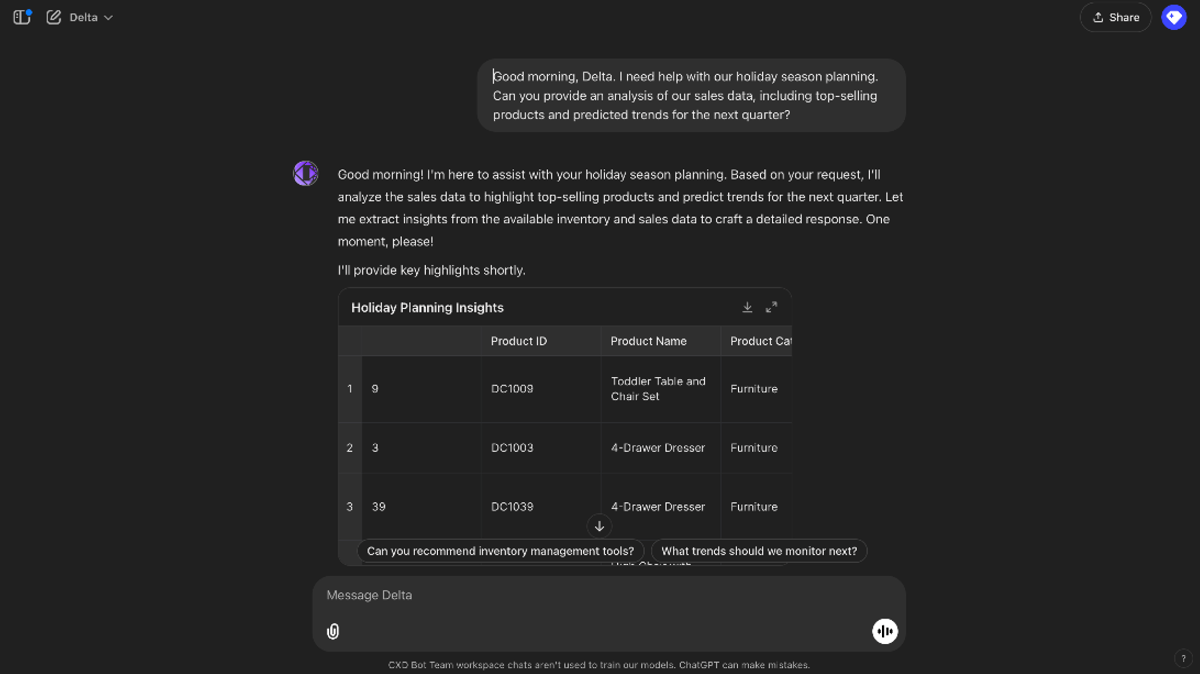
Delta (Ikigai Bot) is a Custom GPT, powered demand forecasting assistant for Delta Children. It analyzes historical sales data, flags dead-stock and out-of-stock risks, recommends restocking actions, and helps teams work faster through summaries and draft emails.

Check out the prototype here.

TL;DR ๐Ÿงพ

Delta Children needed more reliable forecasting support for inventory quantity, location, and planning decisions.

I designed and refined an AI companion for demand planners that improved the experience through clearer responses, better historical grounding, and more useful day-to-day support. Supported by research on Delta's planning challenges and refined through 2 rounds of user testing.

AT A GLANCE

100%

Email Drafting Automated

3

Critical KPIs Unlocked

Product Preview

Background

When supply chains outpace visibility

Delta Children, a leading manufacturer of infant and children's furniture, needed more reliable forecasting support to manage inventory and respond to changing market conditions.

Out-of-stock products account for an estimated 25% of lost global revenue annually, making accurate demand planning critical for inventory and supply-chain teams.

Demand planners had to balance data, intuition, and external signals, often using tools that could generate recommendations but not clearly explain them.

At Delta, a Demand Planner is responsible for forecasting customer demand and planning inventory while accounting for factors such as seasonality, trends, and market shifts.

Problem Statement

Smarter forecasting, fewer blind spots

Demand planners struggled with AI tools that gave forecasts without showing the reasoning, making it difficult to trust outputs, catch errors, or justify decisions to cross-functional teams.

How might we help Delta Children's demand planners trust and act on AI-generated forecasts by making the reasoning transparent and the tool feel like a genuine thinking partner?

Why This Mattered

Delta Children operates at a meaningful scale, which makes forecasting errors costly.

Scale

$34M in annual revenue with hundreds of thousands of products sold yearly.

Logistics

Manufacturing in South Carolina and China, with warehouses in California.

Business Goal

Balance operational speed with responsible growth.

DESIGN DIRECTION

Several constraints shaped the direction of Delta

Transparent Reasoning

Delta shows how forecasts were generated so planners can understand and verify outputs.

Explainable Recommendations

Every recommendation includes context, including the data used, assumptions made, and uncertainty involved.

Human-Centered Support

The bot acts as a thinking partner that supports planner judgment rather than replacing it.

These principles guided the design toward explainable outputs and conversational reasoning rather than a black-box forecasting dashboard.

Solution

Delta logo

A conversational AI companion for demand planners, designed to support judgment, not replace it

Delta helps planners navigate supply chain decisions through transparent forecasting, plain-language explanations, and actionable recommendations

Using historical sales data to flag risks before they become costly, and supporting daily workflows through summaries, draft emails, and cross-functional communication.

๐Ÿ”ฎ

Transparent Forecasting

Shows the reasoning behind each forecast, including data, patterns, and uncertainty.

๐Ÿ“ฆ

Risk Detection

Flags dead-stock and stockout risks before they become costly.

โœ‰๏ธ

Workflow Support

Helps planners move faster with summaries, draft emails, and cross-functional communication.
Research

Understanding Real Workflows

To understand how an AI assistant could support demand planners in real workflows, we studied their day-to-day responsibilities, decisions, and collaboration patterns.

Stakeholder Input

Delta Children - VP of Procurement

In an early conversation with Delta Children's VP of Procurement, we identified three core planning questions the bot needed to support:

1

What inventory quantity and cost would support the next 12 months of demand?

2

Where should inventory be allocated by style and quantity?

3

How could planners make those decisions with more confidence and less manual analysis?

This shaped the bot's focus around real planning decisions rather than generic AI assistance.

Four high-value use cases emerged:

01

Quick Access to Data & Insights

Demand planners needed fast answers to straightforward forecasting questions without searching across multiple dashboards.

Example

Planner
"What is the forecasted demand for toddler beds next quarter?"
Delta
"Forecasted demand is 1,200 units, with projected growth of 8% from the previous quarter."
02

Scenario Analysis

Planners needed to test "what-if" scenarios to compare options and understand how changing variables could affect demand.

Example

Planner
"What happens to demand if there's a 10% increase in raw material costs?"
Delta
"A 10% cost increase could reduce demand by 3%. Would you like to see adjusted inventory levels?"
03Future Support Area

Collaboration & Task Management

Planners spent significant time coordinating with forecasting, finance, sales, and supply chain teams through meetings and email.

04Future Support Area

Market & Trend Insights

Planners needed visibility into external trends and market shifts so they could respond proactively rather than reactively.

Prototype, Testing & Iteration

From concept to MVP ๐Ÿš€

Delta evolved through two structured rounds of testing, moving from a low-fidelity concept to a refined MVP grounded in real demand-planning workflows.

Evolution

Delta 1.0
Low-Fidelity
Testing 1
Delta 2.0
Final Prototype
Testing 2
Delta 3.0
MVP โœฆ
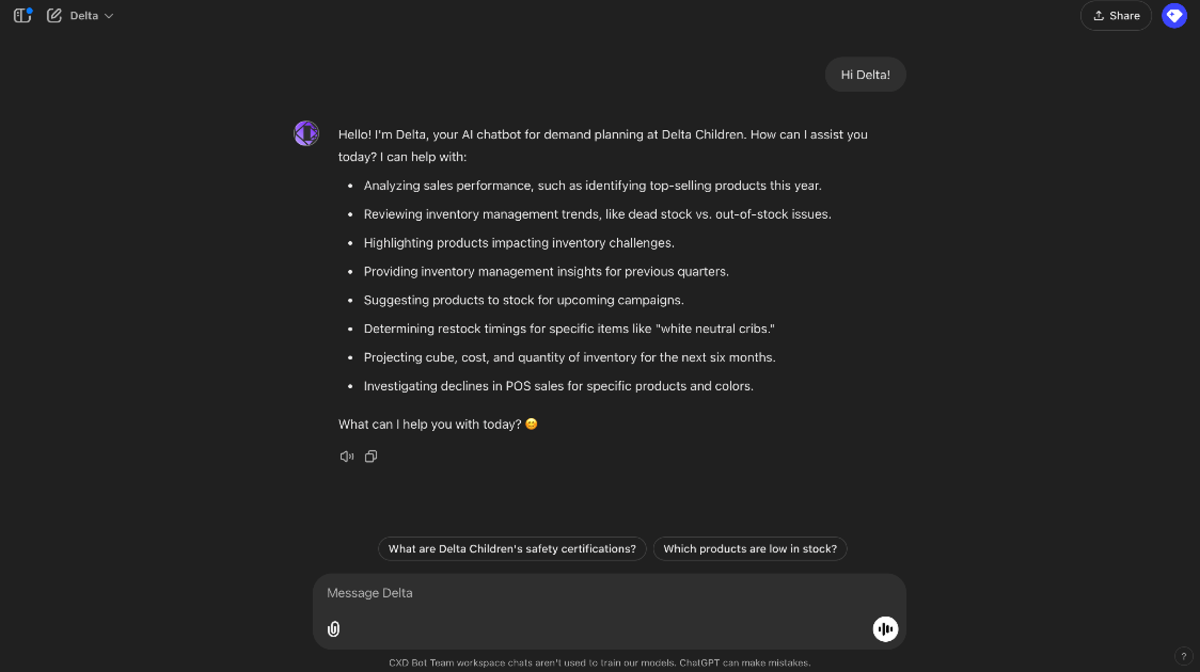
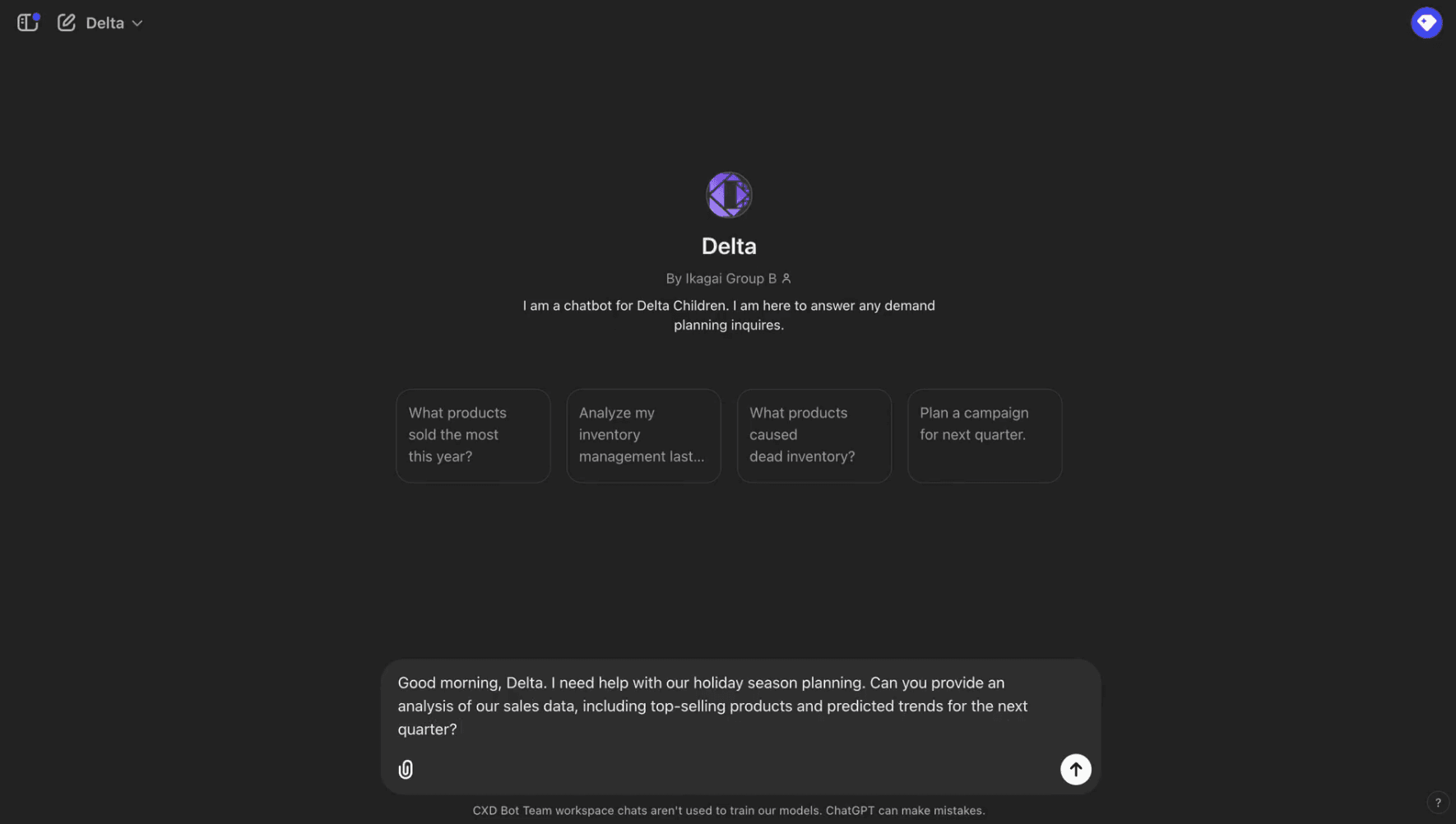
Delta 1.0 - Welcome UI screenshot

Delta 1.0 to Delta 3.0 - from basic responses to historically accurate, data-driven forecasting

Training Delta 1.0 - four foundations

๐Ÿง

Bot Persona

Calm, confident, and professional

โš™๏ธ

Core Capabilities

Forecasting, insights, product research, strategy

๐ŸŽฏ

Target Audience

Demand-planning leaders who value data-driven decisions

๐Ÿท๏ธ

Brand Context

Safe, high-quality products for families

Delta 1.0 responding in line with Delta Children's brand identity

Delta 1.0 responding in line with Delta Children's brand identity

Testing setup

2rounds
4participants
  • Demand planning, procurement & operations
  • Finance & forecasting leadership
  • UserTesting.com platform

We evaluated

  • Relevance of responses
  • Conversation quality and style
  • Suggestions for improvement
  • Usefulness in real workflows

Participant results

ParticipantRoleAttemptsQualityKey suggestion
P1Procurement Manager2 attemptsWarm, easyInclude sources to build trust
P2Owner Manager2 attemptsProfessionalMore specific responses
P3Finance Director3 attemptsWordy, confusingConcise and specific

Round 1 usability testing results with 3 participants

What Worked โœ…

  • Speed of responses for straightforward questions
  • Professional tone that felt confident and appropriate
  • Easy, natural interaction experience

What Needed Improvement ๐Ÿ”ง

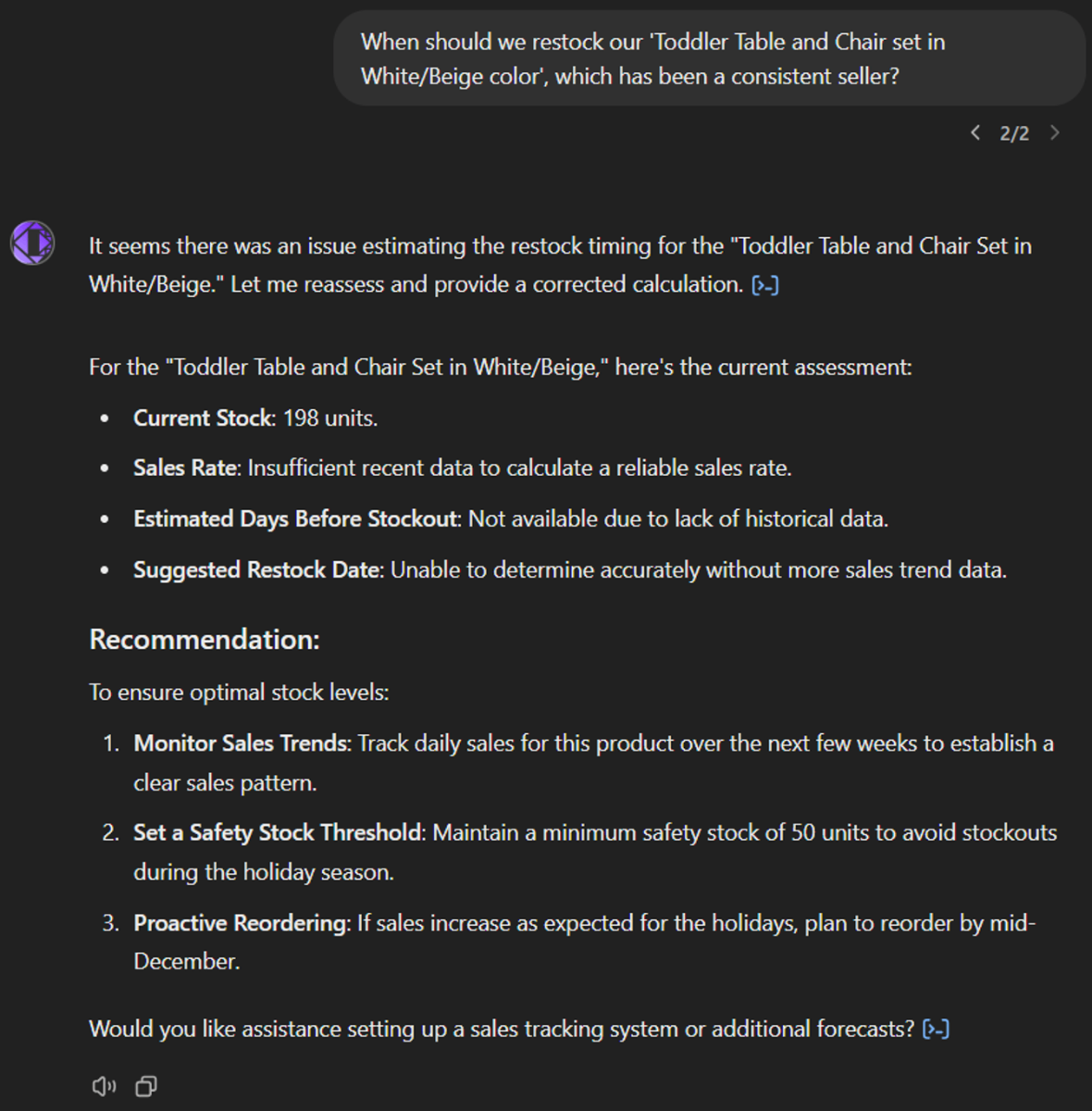
  • Low relevance: needed 2-5 attempts for a satisfactory answer
  • Low trust: responses lacked sourcing and supporting context
  • Low specificity: some answers felt vague, verbose, or confusing
  • Weak forecasting credibility: felt more like a generic procurement tool

Design decisions

Delta 1.0 to 2.0

Designing a structured conversation flow

To reduce vague responses and improve user confidence, I defined a clear eight-step conversation architecture that guided every Delta interaction from opening to resolution.

01Greeting
02User Query
03Response
04Follow-up
05Suggestions
06Data Integration
07Email Drafting
08Feedback

Delta 1.0 to 2.0

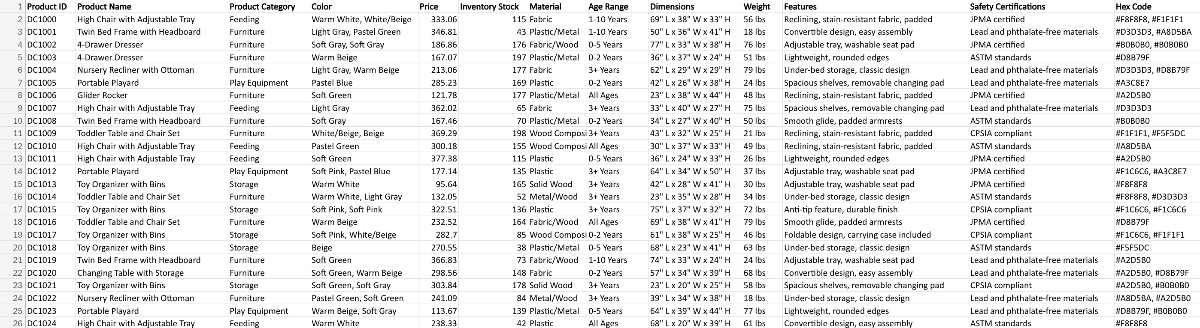
Adding real inventory data to build trust

Users flagged that Delta's responses felt generic. Integrating actual inventory data transformed abstract recommendations into grounded, auditable insights that demand planners could act on.

Before

Responses relied on general knowledge with no product-specific context or sourcing.

After

Delta referenced live inventory data, giving planners specific, sourced answers they could trust.

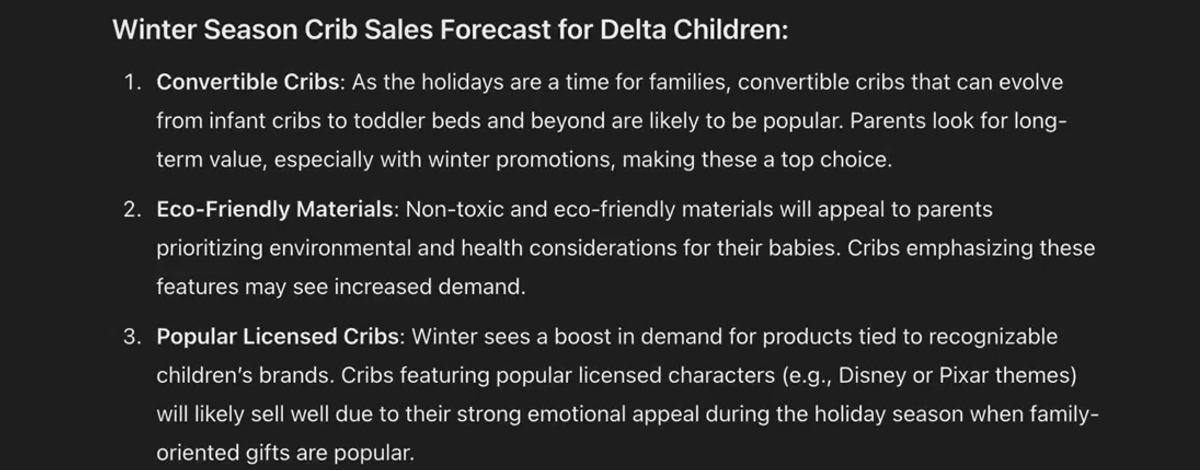
Inventory spreadsheet integration screenshot

Delta 2.0 to 3.0

Adding purchasing dates to unlock real forecasting

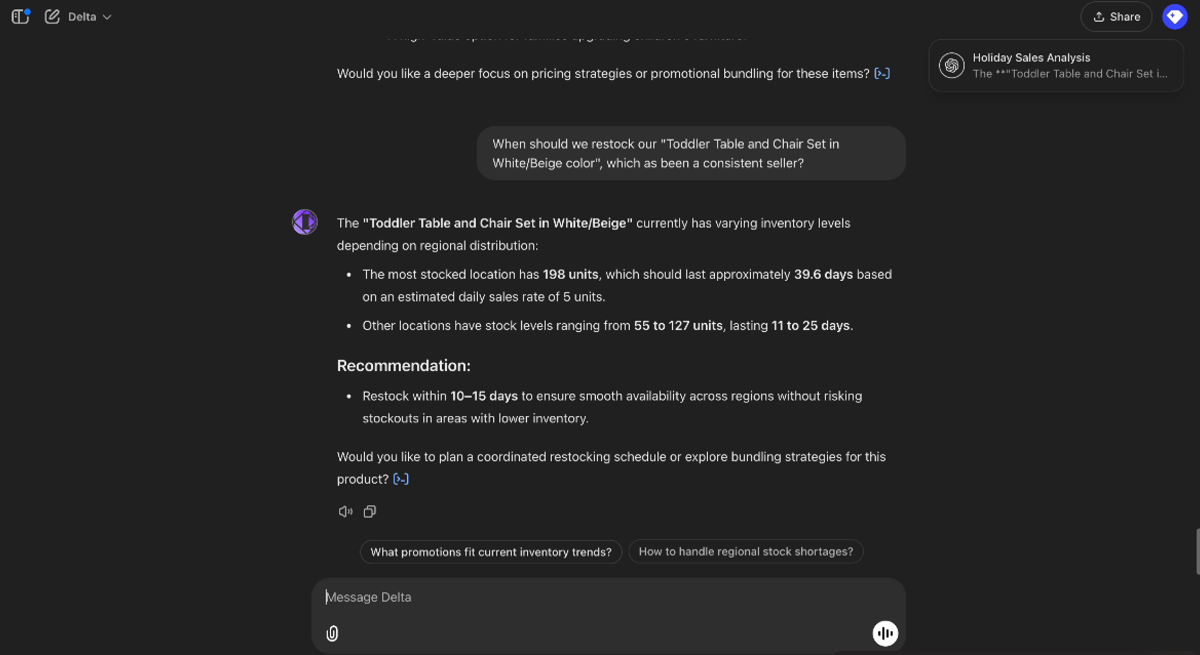
Without time-based data, Delta could describe inventory but couldn't forecast. Introducing purchasing dates enabled historically accurate trend analysis and demand projections.

Before

Inventory data existed but lacked temporal context, forecasting was impossible without dates.

After

Date-stamped entries enabled Delta to surface trends, seasonality, and forward-looking forecasts.

Delta 2.0 forecast view screenshot

What did not move forward

Open-Ended Prompting

Early testing explored giving users a fully open prompt interface with no guidance or structure. While flexible, it produced inconsistent results, participants defaulted to vague queries, and Delta's responses suffered as a result. A guided, structured flow consistently outperformed open-ended prompting and was carried forward into the MVP.

Each round of testing made Delta more trustworthy, more specific, and more aligned with how demand planners actually work.

Delta 3.0 MVP - final screenshot

Delta 3.0 MVP responding with historically accurate, data-driven inventory forecasts

Success Metrics

Impact ๐Ÿ“ˆ

Final prototype delivered to Ikigai's team for ongoing development and implementation.

๐Ÿ“Š

3

Critical KPIs Enabled

Built a Custom GPT enabling instant calculation of turnover, sell-through, and stock-out rates from 100+ rows of structured inventory data

โœ‰๏ธ

100%

Email Drafting Automated

Cross-functional email drafting supported directly within the prototype workflow.

Reflection

Reflection ๐Ÿชž

This project was my first deep dive into enterprise AI design, and it changed how I think about the relationship between users, data, and trust.

๐Ÿข Working with a real company changes everything

Designing for an actual business with real users and real stakes pushed me to think beyond aesthetics, every decision had to be grounded in genuine user needs and business constraints.

๐Ÿง  Trust is designed, not assumed

Building user trust in an AI tool required deliberate design choices around transparency, tone, and explainability. Users needed to feel in control, not replaced.

๐Ÿ” Iteration is the process

The jump from Delta 1.0 to 2.0 came entirely from listening to users during testing. No amount of upfront planning could replace the insight that came from watching real users interact with the product.

next project

AfrECC - Cancer Support

Crafting a compassionate digital resource for African Caribbean cancer patients navigating their care journey.

UX DesignHealthcareWeb

End-to-end product and UX designer crafting thoughtful digital experiences.

Built with Readdy & iced matcha lattes ๐Ÿต